5 Things That Get Letters Ignored (and How to Fix Every One of Them)

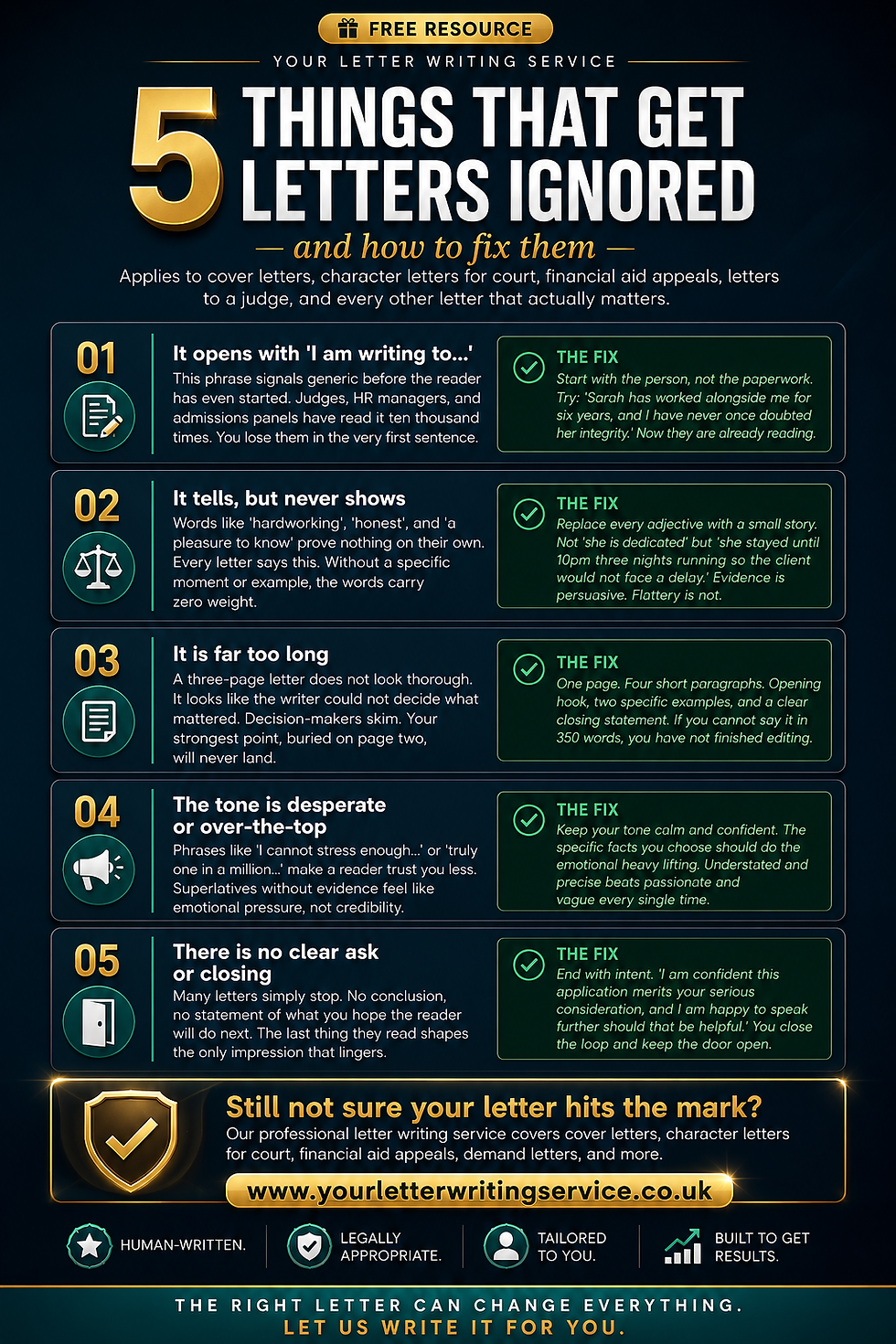
Most letters that fail do not fail because the writer had nothing to say. They fail because of five specific, fixable mistakes that signal to the reader, within the first few lines, that this letter is not going to be worth their full attention.
This applies to every letter that matters. Cover letters for jobs. Character letters for court. Financial aid appeals. Complaint letters to banks, councils and the NHS. Letters to judges, headteachers, employers and the DWP. The audience changes. The five mistakes do not.
What follows is the extended version of our free infographic. The infographic gives you the headlines. This article gives you the full explanation, the examples that show why each mistake loses you the reader, and the specific fixes you can apply before you send anything.
Mistake 1: It Opens With ‘I Am Writing To’
This is the single most common opening in formal letters. It is also the one that loses readers fastest.
‘I am writing to’ signals nothing. Every letter is written to do something. The phrase adds no information. Worse, it tells the reader, before they have read a single substantive word, that this letter is going to be generic. Judges have read it ten thousand times. HR managers skim past it automatically. Admissions panels see it and their attention drifts before the first sentence has finished.
The problem is not just the phrase itself. It is what the phrase represents: a writer who started with the form rather than the substance. Someone who opened a letter the way they were taught to open a letter, rather than someone who started with the most important thing they had to say.
Why it matters in practice
Think about what a judge, a manager or a decision maker is actually doing when they read a letter. They are usually reading it quickly, alongside many others, looking for the reason to keep reading. The opening sentence is your audition. If it is a stock phrase they have seen thousands of times, the audition is over.
The reader’s attention is not lost slowly. It is lost in the first sentence, and it rarely comes back.
The fix
Start with the person, not the paperwork. Start with the most specific, most compelling thing you have to say.
If you are writing a character letter for court, do not open with the writer’s name and relationship. Open with the moment that best illustrates the person’s character.
Sarah has worked alongside me for six years, and I have never once doubted her integrity.
Now the reader is already in a story. They want to know more. The writer’s name and relationship can follow in the second sentence.
If you are writing a complaint letter, do not open with ‘I am writing to complain about.’ Open with what happened.
On 14 March I was charged £340 for a service that was never delivered, despite two written requests for a refund in the weeks that followed.
That sentence creates immediate forward momentum. The reader knows what happened, knows it was a significant amount, and knows the writer has already tried to resolve it. They are already forming a view. That is exactly what you want.
The rule is simple: the first sentence should be the most interesting thing you could possibly say. If it is not, rewrite it until it is.
————————————————————
Mistake 2: It Tells, But Never Shows
This is the mistake that makes letters feel hollow even when they are written with genuine feeling. Words like ‘hardworking’, ‘dedicated’, ‘honest’, ‘a wonderful person’ and ‘a real asset’ carry almost no weight.
This is not because the sentiments are untrue. It is because every letter says them. Every character reference describes the defendant as a devoted family man. Every cover letter calls the applicant a team player. Every complaint describes the company’s behaviour as unacceptable. When every letter uses the same language, the language means nothing.
The reader has no way to distinguish between the letter where the writer genuinely believes this and the letter where it is filler. So they discount it entirely, and look instead for the specific detail that only someone with real knowledge of the person or situation could provide.
Why it matters in practice
Consider two character letters for the same person. Both are supporting the same defendant at a sentencing hearing.
The first says: ‘John is a hardworking and dedicated family man who is deeply committed to his children. He is an honest person and his behaviour in this case is completely out of character. I have known him for fifteen years and have always found him to be trustworthy and generous.’
The second says: ‘John has coached his daughter’s football team every Saturday morning for seven years, including through the period when his own father was seriously ill and he was managing his parents’ care as well. He has never missed a session without arranging cover. I mention this not because I think it excuses what happened, but because it is the truest picture I have of who he is when life is difficult.’
Both letters say John is a good father and a reliable person. Only the second one is persuasive. The difference is not warmth or sincerity. It is specificity.
The fix
Replace every adjective with a small story. For every quality you want to convey, find the incident that demonstrates it. If the person is generous, describe a specific act of generosity. If the complaint is about negligence, describe the specific thing that went wrong and when. If the appeal is about a student’s potential, describe the project or the moment that shows it.
Ask yourself: if I removed this sentence, would the reader have lost any information? If the answer is no, the sentence is doing nothing. Replace it with something that could only have been written by you, about this specific person or situation.
The rule: evidence persuades. Flattery does not.
————————————————————
Mistake 3: It Is Far Too Long
A three-page letter does not look thorough. It looks like the writer could not decide what mattered.
Length is not a signal of effort or seriousness. Decision-makers read under time pressure. A letter that requires three pages to make a point that could have been made in one is asking the reader to do work that the writer should have done. Most of them will not.
The strongest point in a three-page letter is buried, statistically, somewhere in the middle of page two. The reader has already formed their initial impression from page one and may never arrive at the most important thing the writer had to say.
Why it matters in practice
Think about how formal letters are actually read in practice. A judge reviewing pre-sentencing material will read dozens of documents in a morning. An HR manager shortlisting applications may read 80 in a single afternoon. A DWP decision maker processes claims in batches. A complaints handler at a bank works through a queue.
None of these people are reading carefully and charitably, giving every word equal consideration. They are scanning. The letter that gets read fully is the one that signals, from its first paragraph, that every sentence earns its place.
A short letter that makes three strong points is almost always more effective than a long letter that makes those same three points plus seven weaker ones. The weaker points do not add weight to the strong ones. They dilute them.
The fix
One page. Four short paragraphs. An opening hook, two specific examples or evidenced points, and a clear closing statement with a specific ask.
If you cannot say it in one page, you have not finished editing. The editing is not a cosmetic stage at the end of the writing process. It is where the letter is actually written. The first draft externalises your thinking. The editing is where you work out which of that thinking actually matters.
A useful test: read the letter and mark every sentence that could be removed without the reader losing any important information. Remove them. Read it again. If it reads better shorter, it was better shorter.
The rule: if you cannot say it in 350 words, you have not finished editing.
————————————————————
Mistake 4: The Tone Is Desperate or Over-the-Top
Phrases like ‘I cannot stress enough how important this is’, ‘truly one in a million’, ‘an exceptional human being in every sense’ and ‘I beg you to consider’ make readers trust you less.
This is counterintuitive. The writer using this language is usually entirely sincere. They really do feel the urgency. They really do believe the person is exceptional. But the language works against them, because superlatives without evidence read as emotional pressure rather than reasoned argument. And a reader who feels pressured tends to pull back.
There is also a calibration problem. If everything is stressed in the extreme, nothing is. The phrase ‘I cannot stress enough’ is so overused that it has become invisible. The reader’s brain processes it as filler, the same way it processes ‘I am writing to’.
Why it matters in practice
The letters that work are almost always the ones that sound like a credible, measured person giving their honest assessment. Not an advocate. Not a supplicant. Someone whose confidence in what they are saying comes through in the steadiness of the language rather than its intensity.
Consider two sentences making the same point in a financial appeal.
The first: ‘I absolutely cannot overstate how devastating this situation has been for my family and I implore you to take our circumstances into account.’
The second: ‘Since the decision was issued in November, my daughter has been unable to access the therapy she was receiving three times a week. The waiting list for the alternative provision is fourteen months.’
The second sentence is quieter. It is also far more powerful. The specific detail does the emotional work without asking for it.
The fix
Keep the tone calm and confident. Let the specific facts do the heavy lifting. Every time you feel the urge to use an intensifier, ask whether you could replace it with a concrete detail instead.
Instead of ‘this had a devastating effect on my health’: describe specifically what happened to your health and when.
Instead of ‘she is truly exceptional’: describe the specific thing she did that made you think that.
The rule: understated and precise beats passionate and vague every single time.
————————————————————
Mistake 5: There Is No Clear Ask or Closing
Many letters simply stop. The writer has said everything they wanted to say and then the letter ends. No conclusion, no statement of what they hope the reader will do, no clear next step.
This is a significant missed opportunity. The last thing the reader reads shapes the impression that lingers. A letter that ends without a clear ask leaves the reader without direction. What do you want them to do? When? How?
It also signals a lack of confidence. A writer who does not close clearly is often a writer who does not quite believe they have the right to ask for what they want. That lack of belief communicates itself.
Why it matters in practice
Think about the letters you receive in daily life. The ones that produce an action from you are almost always the ones that made the action obvious and easy. The ones that produce nothing are usually the ones that left you uncertain what you were supposed to do next.
The same dynamic applies to every formal letter. A judge reviewing character references before sentencing should finish reading yours knowing exactly what you are asking them to take into account. A hiring manager should finish your cover letter knowing what you want to happen next. A complaints handler should finish reading your complaint knowing precisely what resolution you are seeking.
The fix
End with intent. State clearly what you are asking for, what you are offering, or what you expect to happen next.
For a character letter: ‘I write this knowing what it is he has done, and I am confident it does not define who he is. I hope you will take this into account.’
For a cover letter: ‘I am confident this application merits your serious consideration, and I am happy to speak further should that be helpful.’
For a complaint: ‘I am asking for a full refund of the £340 charged in error, confirmation of the steps taken to prevent recurrence, and a written response within ten working days.’
In each case, the closing tells the reader what you want and signals that you expect a response. You close the loop and keep the door open.
————————————————————
The Checklist: Five Questions to Ask Before You Send
Before you send any important letter, run through these five questions.
Does it open with ‘I am writing to’? If yes, rewrite the first sentence. Start with the most specific and compelling thing you have to say.
Does it tell without showing? For every claim or quality described, is there a specific example or piece of evidence? If not, add one or cut the claim.
Is it longer than one page? Read it and mark every sentence that adds nothing. Remove them. If it is still over a page, keep editing.
Does it use intensifiers or superlatives without evidence? Replace each one with a concrete detail.
Does it end with a clear ask? If not, add one final sentence that states what you want to happen next.
A Note on Why This Is Hard
None of these mistakes are made by careless writers. They are made by people who care about the letter and are trying to do it right. The reason they happen is that formal letter writing is counterintuitive in a specific way.
Our instinct, when something matters, is to make it clear that it matters. We reach for superlatives. We explain at length. We open with the formal conventions that feel safe. We add more, in case less was not enough.
The letters that work do the opposite. They trust the reader. They say the most important thing first and then stop when they have said it. They let specific facts carry weight that adjectives cannot. They close with confidence rather than hope.
This is a skill. It can be learned. But it can also be given to someone else, for the letters where the stakes are too high to practise on.
————————————————————
Download This Guide
The infographic that accompanies this article summarises the five mistakes and their fixes on a single page. Save it to your phone by downloading it here, share it with someone who is working on an important letter, or use it as a checklist before you send anything that matters.
If you would like guides like this delivered directly, along with practical letter-writing advice for complaints, appeals, legal correspondence and more, you can subscribe to receive updates from LetterLab by using the subscribe form in the footer of our website. No selling. Just useful content for people who need to write letters that work.
And if the letter you are working on is one you would rather not get wrong, the team at LetterLab writes formal letters for people across the UK. We are currently offering a small number of free letters in return for an honest review.


Comments